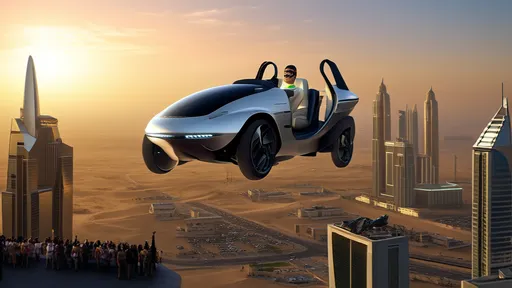
In a groundbreaking moment for the future of urban mobility, a Chinese flying car successfully completed its first overseas public manned flight demonstration in Dubai. The event marks a significant milestone not only for the manufacturer but for the entire emerging industry of electric vertical takeoff and landing (eVTOL) vehicles. Against the iconic backdrop of Dubai's futuristic skyline, the aircraft elegantly lifted off, hovered, and maneuvered through a pre-determined flight path, showcasing its potential to revolutionize transportation in congested megacities.
The demonstration was conducted by Xpeng Aeroht, a leading Chinese eVTOL developer and a subsidiary of the well-known electric vehicle manufacturer Xpeng. The vehicle, named the Xpeng X2, performed a series of maneuvers that highlighted its stability, low noise levels, and sophisticated flight control systems. The flight lasted approximately 90 seconds, captivating an audience that included government officials, industry experts, and international media. This successful showcase in a global hub like Dubai sends a powerful message about the technical maturity and global ambitions of China's advanced air mobility sector.
The choice of Dubai as the location for this historic flight is highly strategic. The United Arab Emirates has consistently positioned itself at the forefront of technological adoption and innovation. Dubai, in particular, has ambitious plans for integrating autonomous aerial vehicles into its public transport network to alleviate ground traffic congestion. The city's authorities have actively encouraged testing and development in this field, creating a favorable regulatory and business environment. By demonstrating its technology in such a forward-thinking market, Xpeng Aeroht has effectively positioned itself as a serious contender in the race to define the future of urban air travel.
Technologically, the Xpeng X2 represents the cutting edge of eVTOL design. It is an all-electric, two-seater vehicle capable of both manual and autonomous flight. Its enclosed cockpit and sleek, carbon fiber structure give it a distinctively futuristic appearance. The vehicle is powered by eight independent electric motor systems, providing redundancy for enhanced safety. With a target maximum flight time of 35 minutes, it is designed for short-to-medium urban journeys. A key focus of the development has been on noise reduction, a critical factor for public acceptance in dense urban environments. During the Dubai flight, the X2's quiet operation was a notable feature, distinguishing it from the loud roar of traditional helicopters.
This overseas debut is more than just a single flight; it is a statement of intent from the Chinese tech industry. For years, the narrative of technological innovation has been dominated by Silicon Valley. However, Chinese companies are now aggressively investing in and developing next-generation technologies, from artificial intelligence to renewable energy and now, advanced air mobility. The successful demonstration in Dubai proves that Chinese firms are not just participants but are becoming leaders in these frontier fields. It underscores a strategic shift from manufacturing for the world to innovating for the future.
The global market for Urban Air Mobility (UAM) is projected to be worth billions of dollars within the next decade, and the competition is intensifying. Companies from the United States, like Joby Aviation and Archer Aviation, and European players, such as Lilium and Volocopter, are also deep into testing and certification phases. Xpeng Aeroht's public demonstration is a crucial step in this high-stakes race. It builds credibility, attracts potential investors and partners, and provides invaluable real-world data to refine their technology further. The visual proof of a safe and controlled manned flight is an irreplaceable marketing and validation tool.
However, the path from a successful demonstration to commercial operation is fraught with challenges. Widespread adoption of flying cars hinges on overcoming significant hurdles, including the establishment of comprehensive regulatory frameworks, the development of air traffic management systems for low-altitude flights, the construction of necessary infrastructure like vertiports, and, most importantly, gaining public trust. Safety remains the paramount concern. Regulators in aviation are notoriously meticulous, and certifying a new category of aircraft for passenger transport will require exhaustive testing and validation to meet the highest safety standards.
Looking ahead, the implications of this technology are profound. The integration of eVTOLs into urban ecosystems could dramatically reduce commute times, decongest road traffic, and open up new possibilities for urban planning and emergency services. Imagine a future where a trip from a city center to an airport that normally takes an hour in traffic is reduced to a 10-minute silent flight. The demonstration in Dubai brings this vision one step closer to reality. It serves as a tangible preview of a third dimension in urban transportation, complementing ground and underground networks.
In conclusion, the successful overseas manned flight of a Chinese flying car in Dubai is a watershed moment for the aviation and transportation industries. It signals the arrival of Chinese innovation on the global stage in a highly visible and transformative sector. While numerous obstacles remain before we see fleets of flying cars gracing our skylines, this event proves that the technology is viable and advancing rapidly. The flight was not just a test of an aircraft's capabilities; it was a test flight for a new era of mobility, and it passed with flying colors. The world is now watching, waiting to see how this nascent industry will navigate the complex journey from prototype to product, forever changing how we move through our cities.

By /Aug 14, 2025

By /Aug 14, 2025

By /Aug 14, 2025

By /Oct 20, 2025
By /Oct 20, 2025

By /Aug 14, 2025
By /Oct 20, 2025

By /Aug 14, 2025
By /Oct 20, 2025

By /Aug 14, 2025

By /Aug 14, 2025

By /Aug 14, 2025

By /Oct 20, 2025

By /Aug 14, 2025

By /Aug 14, 2025

By /Aug 14, 2025

By /Oct 20, 2025

By /Oct 20, 2025

By /Aug 14, 2025
