High in the Arctic permafrost, buried deep inside a mountain on the remote Norwegian island of Spitsbergen, lies humanity's ultimate insurance policy against agricultural catastrophe. The Svalbard Global Seed Vault, often dubbed the "Doomsday Vault," represents one of the most ambitious biodiversity preservation projects ever undertaken. But this Arctic stronghold isn't alone in its mission - from the slopes of Mount Everest to the frozen landscapes of Antarctica, scientists are creating a global network of seed banks designed to withstand climate disasters, wars, and even asteroid impacts.
The concept sounds like science fiction: enormous underground facilities filled with millions of seed samples, preserved at subzero temperatures, waiting patiently for the day humanity might need to reboot global agriculture. Yet these repositories have become very real and increasingly vital as climate change accelerates biodiversity loss. These seed banks don't just protect against apocalyptic scenarios - they serve as living libraries helping scientists develop climate-resistant crops to feed a warming world.
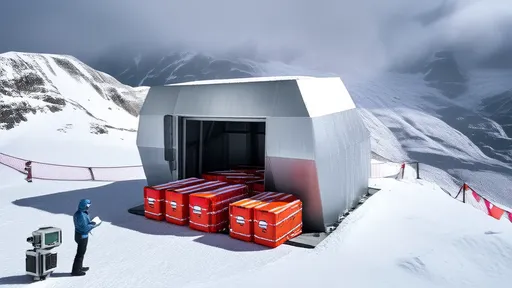
Carved into a sandstone mountain on Spitsbergen, the Svalbard Vault operates like a safety deposit box for the world's crops. Since opening in 2008, it has amassed over 1.2 million seed samples from nearly every country. The location wasn't chosen by accident - the Arctic permafrost provides natural refrigeration, while the remote location offers protection from political instability. The vault sits 130 meters above sea level, safeguarding against rising oceans, and is built to withstand nuclear war. Even if all power fails, the surrounding permafrost would keep temperatures below freezing for weeks.
Meanwhile, at the opposite end of the Earth, another ambitious preservation project has taken root. The South Pole Seed Vault, established in 2010, leverages Antarctica's extreme cold as a natural freezer. Unlike Svalbard's focus on food crops, this facility specializes in preserving wild plant species - particularly those from alpine environments that may hold genetic keys to surviving climate change. Scientists consider these wild relatives of domesticated crops to be potential "climate change fighters," containing traits like drought resistance that could be bred into food crops.
Perhaps most surprising is the emergence of high-altitude seed banks in the Himalayas. The International Centre for Integrated Mountain Development (ICIMOD) has established a network of community seed banks across Nepal, Bhutan, India and Pakistan, with some located at elevations rivaling Everest Base Camp. These facilities preserve traditional crop varieties developed over centuries to thrive in mountain conditions - knowledge that becomes increasingly valuable as climate change pushes agriculture to higher elevations.
"What farmers developed over generations in these extreme environments may hold solutions for feeding the world as temperatures rise," explains Dr. Sanjay Gupta, an agricultural scientist working with Himalayan seed banks. "Some of these traditional barley and wheat varieties can survive frost, drought, and poor soil conditions that would devastate modern commercial crops."
The operation of these seed banks reveals fascinating details about preserving genetic material for centuries. Seeds are carefully dried to 5-6% moisture content, then sealed in specially designed four-ply foil packages. Storage temperatures typically hover around -18°C (-0.4°F), dramatically slowing metabolic activity. Under these conditions, many seeds remain viable for decades or even centuries - wheat and barley can last up to 1,000 years, while sorghum may survive 20,000 years.
But these facilities face unexpected challenges. In 2016, the Svalbard Vault experienced minor flooding from permafrost melt due to unusually warm Arctic temperatures - a stark reminder that even the most carefully designed doomsday preparations aren't immune to climate change. The incident prompted a $20 million upgrade including improved waterproofing and cooling systems. Similarly, Himalayan seed banks must contend with increasing risks from glacial lake outburst floods and landslides in the warming mountains.
Beyond physical threats, seed banks navigate complex political landscapes. The Svalbard Vault operates under Norwegian law but stores seeds owned by nations and institutions worldwide. A carefully crafted legal framework ensures depositors retain ownership rights while Norway provides security. This international cooperation becomes particularly delicate when storing seeds from regions experiencing conflict - the vault already holds duplicates from seed banks in Syria and Ukraine.
The importance of these repositories was tragically highlighted during Syria's civil war, when researchers requested the first-ever withdrawal from Svalbard to rebuild the Aleppo seed bank's destroyed collections. "That moment proved the vault wasn't just theoretical insurance," says Marie Haga, former executive director of the Crop Trust. "It became a very real resource for restoring agricultural heritage wiped out by war."
Looking ahead, scientists are exploring even more futuristic preservation methods. Some facilities have begun experimenting with cryopreservation - storing plant material in liquid nitrogen at -196°C (-320°F) - which could potentially preserve seeds indefinitely. Others are digitizing genetic information, creating "virtual seed banks" that could one day allow 3D printing of DNA sequences. However, most experts agree physical seed banks will remain essential for the foreseeable future.
As climate change accelerates, these biological arks take on new urgency. Crop failures from extreme weather have increased steadily, with multiple breadbasket failures becoming more likely. The UN estimates 75% of crop diversity was lost last century as farmers shifted to uniform commercial varieties. Seed banks represent our best chance to maintain the genetic diversity needed to adapt agriculture to unpredictable future conditions.
"We're not just preserving seeds," reflects Dr. Gupta in the Himalayas, watching farmers deposit heirloom varieties. "We're preserving options - options our grandchildren may desperately need in a world we can't yet imagine." From the Arctic to the Andes, these modern-day Noah's Arks continue their quiet vigil, safeguarding the building blocks of civilization against whatever challenges the future may bring.
By /Aug 7, 2025
By /Aug 7, 2025
By /Aug 7, 2025
By /Aug 7, 2025
By /Aug 7, 2025
By /Aug 7, 2025
By /Aug 7, 2025
By /Aug 7, 2025

By /Aug 7, 2025
By /Aug 7, 2025
By /Aug 7, 2025
By /Aug 7, 2025
By /Aug 7, 2025
By /Aug 7, 2025
By /Aug 7, 2025
By /Aug 7, 2025
By /Aug 7, 2025
By /Aug 7, 2025
By /Aug 7, 2025
By /Aug 7, 2025
