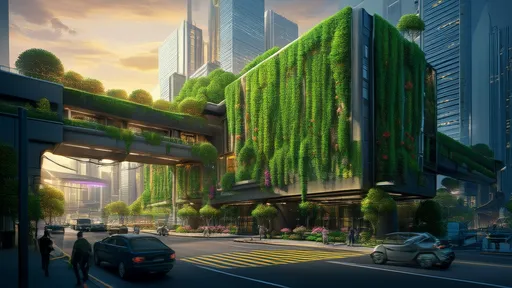
In the heart of our concrete jungles, a quiet revolution is taking root—literally. Across global megacities, architects and ecologists are collaborating on an audacious experiment: transforming skyscrapers into vertical forests that serve as "ecological bridges" between fragmented urban habitats. This isn't mere greenwashing with potted plants on balconies; we're witnessing the emergence of entire ecosystems suspended hundreds of feet in the air, where building facades breathe life back into suffocated cityscapes.
The concept crystallized when researchers observed an alarming phenomenon—songbirds migrating through cities would drop dead from exhaustion, finding no resting spots amidst glass and steel. Vertical forests address this by creating stepping stones of biodiversity. Milan's Bosco Verticale, twin residential towers hosting 800 trees and 15,000 plants, has become an unexpected haven for over 20 bird species. But the real breakthrough came when motion-activated cameras captured something extraordinary: a rare peregrine falcon nesting at 260 feet, using the building's vegetation to teach fledglings to hunt urban pigeons.
What makes these structures revolutionary isn't their aesthetics, but their functioning as active ecological infrastructure. Singapore's Oasia Hotel demonstrates this with its red aluminum mesh facade deliberately designed to mimic forest canopies. Botanists selected specific flowering vines to attract nectar-feeding birds year-round, while the porous structure creates microclimates that reduce ambient temperatures by 4°C—a cooling effect that radiates across entire city blocks. The building has effectively become an artificial mountain, with different plant species thriving at various elevations just as they would on a natural slope.
The engineering challenges are immense. Traditional soil would be too heavy at height, so scientists developed lightweight substrates with hydrogel polymers that retain 40% more water. In Shanghai's Sunqiao District, a prototype uses robotic arms equipped with moisture sensors to tend vertical gardens—a necessary innovation when maintaining plants on the 50th floor. Perhaps most crucially, these projects are rewriting urban zoning laws. New York's recently passed Biodiversity Building Codes now mandate that structures over 25 stories incorporate specific percentages of native plant species to form migratory corridors for pollinators.
Critics initially dismissed these projects as vanity architecture, but the data tells a different story. Thermal imaging shows vertical forests reducing heat island effects by up to 12%, while air quality monitors detect 30% lower particulate matter within 100 yards of such buildings. In Seoul, the G-Tower's green facade has become a laboratory for spontaneous ecological succession—over 38 insect species not intentionally introduced have colonized the structure, including three types of endangered butterflies. This accidental biodiversity underscores how quickly nature claims territory when given even the slimmest opportunity.
The movement is evolving beyond individual buildings. Urban planners in London are experimenting with "green chains"—strategically positioning vertical forests to form aerial wildlife corridors across the city. Bats, which typically avoid light-polluted areas, have been recorded using these high-rise oases as navigation markers during nocturnal migrations. Meanwhile, Mexico City's Via Verde project transformed 1,000 concrete highway pillars into vertical gardens, creating a 40-kilometer vine corridor that connects two isolated forest reserves. Ecologists recently documented the first jaguarundi sightings along this route in decades.
Perhaps the most profound impact lies beneath our feet. These aerial ecosystems are reshaping urban hydrology. In Chongqing, China, where vertical forests cover entire mountain-facing apartment blocks, the structures now intercept 60% of stormwater runoff that previously caused catastrophic flooding. The plants' roots form symbiotic relationships with mycorrhizal fungi that break down airborne pollutants, effectively turning buildings into giant air filters. Rainwater captured by the canopy vegetation has reduced the city's drainage burden by an estimated 800 million gallons annually.
The psychological effects are equally transformative. A Tokyo hospital incorporating vertical forests reported 22% faster patient recovery rates in rooms with direct views of the vegetation. Workers in such buildings demonstrate higher cognitive function scores, particularly in creative problem-solving tasks. This isn't just about bringing nature closer—it's about redefining humanity's relationship with the vertical dimension of cities. As one Milanese resident tending her 32nd-floor tomato vines remarked, "I don't live in an apartment anymore; I inhabit a cliffside."
Looking ahead, the next generation of vertical forests won't merely mimic nature—they'll actively regenerate it. Berlin's proposed Himmelspark complex will feature artificial rock faces designed to attract nesting kestrels, while its irrigation system will create microhabitats for endangered moss species. In Los Angeles, architects are testing "bio-receptive concrete" that encourages spontaneous lichen growth—a deliberate strategy to accelerate ecological succession. These aren't buildings with plants; they're architectural organisms that grow, adapt and participate in urban ecosystems.
The ultimate test may come in desert cities. Dubai's upcoming "Forests in the Sky" project aims to create self-sustaining vertical ecosystems using fog-harvesting technology and native drought-resistant species. If successful, it could blueprints for greening the world's most inhospitable urban landscapes. As climate change accelerates, these living towers may become arks preserving biodiversity—not in remote wilderness, but where humanity needs them most: in the dense cores of our cities. The age of static architecture is ending; the era of buildings that breathe, bloom and belong to ecological networks has begun.

By /Aug 7, 2025

By /Aug 7, 2025

By /Aug 7, 2025
By /Aug 7, 2025
By /Aug 7, 2025

By /Aug 7, 2025
By /Aug 7, 2025

By /Aug 7, 2025

By /Aug 7, 2025

By /Aug 7, 2025

By /Aug 7, 2025

By /Aug 7, 2025

By /Aug 7, 2025
By /Aug 7, 2025

By /Aug 7, 2025

By /Aug 7, 2025

By /Aug 7, 2025

By /Aug 7, 2025
By /Aug 7, 2025
By /Aug 7, 2025
